Carrier-Grade Cloud Networking for the Modern Enterprise
How enterprises are rethinking cloud networking and why the combination of 6WIND and Equinix Network Edge changes the equation.
Enterprises are running workloads across more clouds, locations, and partners. AI-driven services, real-time analytics, and hybrid multicloud architectures — increasingly including specialized neoclouds purpose-built for GPU and AI workloads — raise the bar for low-latency, secure, and scalable networking. Legacy WAN designs and hardware-centric appliances often have difficulty keeping pace: provisioning can take weeks or months, requires significant upfront hardware investment, and can drive up cloud egress and data transfer costs, making it harder to evolve architectures as requirements shift. At the same time, rapid expansion into new regions and the need to interconnect with a growing ecosystem of cloud, SaaS, and partner environments raise expectations for consistent routing and security policy across the entire footprint.
What’s changing in enterprise connectivity (and why it matters):
- Interconnection is becoming the new edge: more traffic paths terminate at cloud on-ramps, SaaS, and partner ecosystems rather than a single corporate hub.
- Multi-cloud connectivity is shifting from a one-time build to ongoing policy operations across providers, regions, and segmentation domains.
- Security services are expected to scale and move with the topology (segmentation, inspection, encryption) instead of creating centralized points.
- Provisioning speed has become an architectural constraint: if adding capacity or a metro takes weeks, the network becomes the limiting factor.
- Cost visibility is increasing as egress, interconnect, and recurring consumption models make placement and traffic engineering decisions more material.
6WIND VSR now available on Equinix Network Edge, makes it possible to place scalable routing, security enforcement, and high-scale IPsec VPN connectivity close to cloud and ecosystem interconnection points. The result is carrier-grade, multi-service cloud networking deployed in minutes to global interconnection hubs, without requiring physical hardware.
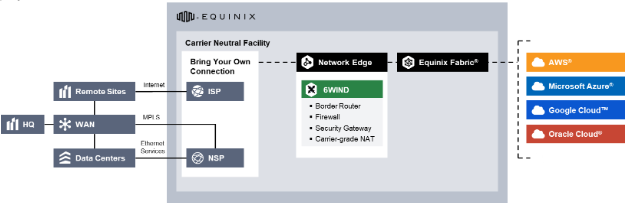
Figure 1: 6WIND VSR on Equinix Network Edge
Real Scenarios, Real Results
Consider four scenario enterprises face today:
Multi-cloud routing at scale. Application footprints rarely stay put. As teams add a new cloud, expand into a new region, or connect to additional services, routing policy has to remain consistent across environments. In hardware-centric designs, that change often cascades into deploying routers per metro, staging configurations, and waiting through procurement and maintenance windows. With 6WIND vBR on Equinix Network Edge, software-defined routing can be instantiated in minutes at the interconnect layer, accelerating time-to-service while preserving control of routing policy.
Security enforcement without bottlenecks. Segmentation tends to expand over time, new tenants, partners, and sensitive workloads introduce policy requirements that need to follow traffic across clouds and interconnects. Centralized stacks and hardware-bound firewalls may introduce bottlenecks and limit flexibility, and scaling frequently means upsizing appliances rather than adding capacity elastically where it’s needed. 6WIND vFW supports rapid deployment in global metros, placing enforcement near cloud interconnection points so security scales with the topology instead of constraining it.
Encrypted connectivity everywhere. Encryption is increasingly a default requirement for site-to-cloud, SD-WAN-to-cloud, cloud-to-cloud, and partner connectivity, often spanning multiple metros. Traditional VPN appliances can struggle to deliver high tunnel scale and throughput without large compute footprints and operational overhead. 6WIND vSecGW provides high-scale IPsec VPN capacity with high throughput and a low compute footprint, simplifying encrypted network services across the Equinix ecosystem.
Centralized internet breakout, lower egress costs. Cloud egress and Network Address Translation (NAT) processing can become significant line items in enterprise cloud bills. Hyperscaler NAT Gateways charge premium per-gigabyte rates for traffic processing, and each cloud and region typically requires its own NAT instance — increasing costs and fragmenting internet traffic policy. 6WIND vCGNAT on Equinix Network Edge consolidates internet breakout across all connected clouds into a single Carrier-Grade NAT (CGNAT) instance with unified policy control, leveraging Equinix’s price-optimized internet access to better control costs.
What You Gain
Together, Equinix and 6WIND remove networking as a bottleneck to digital transformation. Enterprises gain:
- Performance — High throughput with low latency; edge-based routing reduces backhaul bottlenecks.
- Cost efficiency — Can deliver lower TCO vs. hardware appliances; pay-as-you-grow NaaS licensing model.
- Agility — Deploy across global metros in minutes; scale dynamically with demand.
- Security and governance — Integrated firewall, IPsec, and DDoS protection with multi-tenant segmentation on a neutral, sovereign platform.
Equinix provides the neutral, global interconnection platform while 6WIND delivers the software-defined networking capabilities. The result is high-performance routing, low-latency firewalling, and scalable encrypted connectivity where it matters most, at the digital edge.
Get Started
6WIND VSR is available now on Equinix Network Edge. To learn more, download the Partner Solution Brief or contact 6WIND at equinixedge@6wind.com or Equinix account team to request a proof-of-concept deployment in your target metro.
6WIND is the worldwide leader in high-performance Virtual Service Router software solutions, empowering service providers and enterprises to replace expensive hardware with cloud-native, sustainable virtualized networking. Learn more at 6wind.com.