Accelerating the AI Era: Why Frontend Networking is the Key to Unlocking GPU Potential
Artificial intelligence is rapidly shifting from experimentation to enterprise-grade production. We are seeing an explosion in generative models, agentic applications, sovereign AI platforms, and GPU-as-a-Service (GPU-aaS) offerings. As organizations scale their AI infrastructure, the network plays an increasingly decisive role.
When most architects think about “Networking for AI,” they think of the backend network: the high-speed compute fabrics, such as NVIDIA InfiniBand or RoCE (RDMA over Converged Ethernet), that connect GPUs to one another. But GPU clusters depend on fast, secure frontend access just as much as on backend GPU-to-GPU connectivity.
The frontend network connects users, data sources, APIs, and inference clusters. It plays a decisive role in performance, user experience, and cost, and in shared environments it must also provide strict isolation, multi-tenancy, and security.
The Challenges of AI at the Network Edge
At the network edge, AI workloads place demands on infrastructure that traditional architectures struggle to meet:
- High packet rates: Multi-user inference APIs generate packet rates that the network must sustain.
- Tenant isolation: Shared environments require strong isolation with fine-grained observability.
- Service chaining and policy enforcement: Traffic needs real-time service chaining and dynamic policy enforcement.
- Cost-efficient scaling: Infrastructure must scale efficiently to match workload and cost constraints.
Meeting these requirements calls for a pre-integrated, infrastructure-grade networking platform that extends hyperscaler-class capabilities to a broader set of AI adopters.
Offload, Accelerate, and Isolate
6WIND’s Networking for AI solution combines two components:
- Virtual Service Router (VSR): Acts as the secure ingress/egress point for AI clusters, providing IPsec encryption, NAT, firewall, and VPC interconnects, with multi-tenancy support for stronger isolation.
- Virtual Host Network Accelerator (vHNA): An accelerated host-based router that extends BGP EVPN overlays to pods and clusters, ensuring reliable and secure multi-tenant workload isolation.
Both components can run as software functions or be offloaded to NVIDIA BlueField-3 DPUs. On BlueField-3, networking runs in the hardware-accelerated data path, enabling inline packet processing, deterministic low-latency forwarding, and high throughput at scale. This design increases system efficiency, improves workload density, and keeps CPU resources dedicated to AI training and inference.
Key benefits:
- Optimized utilization: Predictable data movement, with CPUs fully available for AI workloads.
- Faster AI services: Ultra-low latency and high throughput for real-time applications.
- Secure multi-tenancy: Strong tenant isolation with VRF, ACLs, and firewalling for compliance and privacy.
- Elastic scaling: Dynamic expansion of routing, policies, and overlays as workloads grow.
- Simplified infrastructure: Software-defined, DPU-accelerated networking reduces hardware and management overhead.
- Smarter cost control: Policy-based traffic steering aligns GPU usage with cost, SLA, and compliance needs.
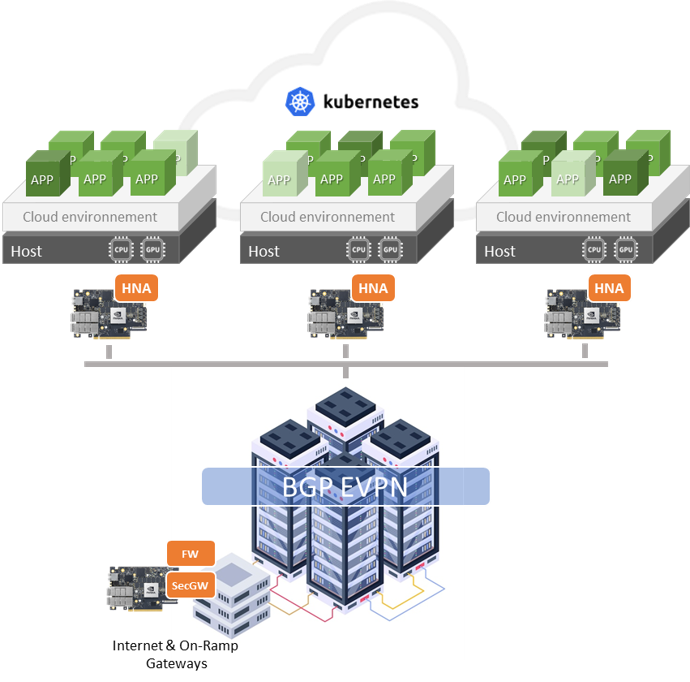
Offload, Accelerate, and Isolate at the Infrastructure Layer
Real-World Applications
- Inference service chaining: AI requests sometimes traverse multiple services before reaching a model endpoint. Functions such as firewalls, NAT, and logging can be chained inline on NVIDIA BlueField-3 DPUs, supporting regulated environments with custom security and observability while maintaining low latency.
- GPU-aaS platforms: Providers of shared GPU clusters need tenant isolation and predictable performance. The solution enables per-tenant VPCs, firewall and NAT policies, and network-level SLAs, all accelerated by BlueField-3, so each tenant receives consistent throughput and providers can scale services efficiently.
- Enterprise AI: Enterprises running AI across multiple departments can build dynamic overlays that enforce segmentation and resource boundaries. Sensitive groups such as R&D and finance get isolated, auditable traffic paths while still using shared infrastructure.
- Hybrid and sovereign AI: Secure overlay networking across on-premises, cloud, and sovereign domains helps AI services meet data localization requirements while maintaining seamless performance across distributed environments.
Conclusion
AI workloads need more than raw compute. By combining 6WIND’s Virtual Service Router and Virtual Host Network Accelerator with NVIDIA BlueField-3 DPUs, cloud providers, enterprises, and GPU-aaS operators can get low-latency, secure, multi-tenant connectivity for Kubernetes-based AI workloads, in a productized platform that simplifies operations and accelerates deployment.
Learn More: Contact us or read the solution brief.